
Château de Walzin, on the Lesse
Château de Walzin: the castle you see from across the Lesse
Château de Walzin is a private castle on a cliff above the Lesse, near Dinant. You cannot go in. You see it from across the river, and that is where our coffee comes out.
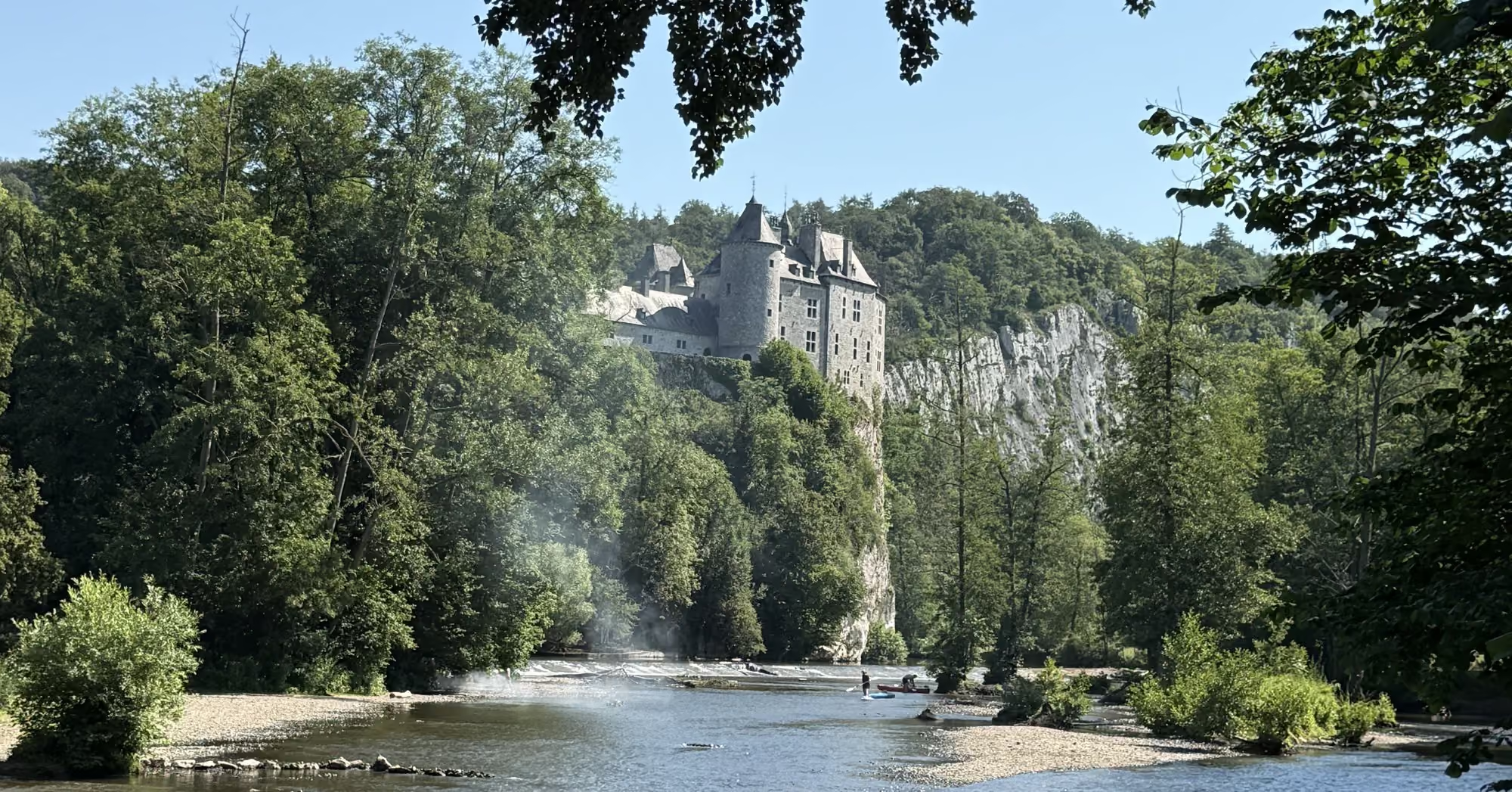
Château de Walzin stands on top of a cliff above the Lesse, near Dinant. It is private property and still lived in, so you cannot go in. You see it from across the river, and on our days around Dinant that is where the coffee comes out.
How I found it
I grew up in Zottegem, a small town near Ghent, in the Dutch-speaking north of Belgium. Many places in the south I first saw as a child, with my family. Walzin I found later, as a young man, kayaking the Lesse and camping wild with friends.
That is still the classic way to see it. Kayakers put in upriver at Houyet and paddle 7, 14 or 21 kilometres down to Anseremme, where the Lesse runs into the Meuse. On the way, the river takes you right below the castle, and you look straight up at it from the water. That is how I saw it first.
It was a long time before I showed it to anyone. The spot I use now is known locally, but nobody pushes it. So you often have it almost to yourself.
I include it because it is not a museum or a foundation. It is a family home on a rock. That is the first thing I tell guests when we get there.
A castle above the Lesse, not the Meuse
Walzin stands above the Lesse, not the Meuse. Below the cliff, kayakers come past all day on their way down to Anseremme. On the right, you can see the old stables, empty now.
The Ardennes tourist board, Visit Ardenne, calls Walzin one of the largest castles in Belgium. It sits at the top of a cliff about 50 metres high. The board also says the best way to see it is from the water.
There is no visitor website for Walzin, because the castle does not take visitors. For the region around it, the official source is Explore Meuse, the tourist board for Dinant and the Meuse valley.
The history of Walzin
Walzin was built to guard a river crossing. In the Middle Ages, the road into Dinant from the south crossed the Lesse at a ford below this rock. Whoever held the rock held the road. A castle stood here by the 11th or 12th century. Sources do not agree on the exact start: some say the 11th century, others say building began in the 13th.
The lords of Walzin served the prince-bishops of Liège, who ruled Dinant. That put the castle in the middle of their wars. In the 1400s it was besieged and damaged more than once, in the wars with the Duke of Burgundy and with Maximilian of Austria. Around 1480, the castle sheltered Guillaume de La Marck, a warlord known as the Boar of the Ardennes.
One part from that time still stands: a 15th-century tower shaped like a horseshoe, with four openings for cannon. In 1554, during the war between Emperor Charles V and King Henry II of France, a French army came through and burned the castle.
By 1850, little more than a ruin was left. That year, Alfred Brugmann bought it. In 1881, the architect Émile Janlet restored it in a Spanish-Flemish style. That is the castle you see on old postcards from around 1900.
Between 1930 and 1932, Baron Frédéric Brugmann de Walzin had it rebuilt once more, by the architect Octave Flanneau. This time he chose the Mosan style, the old building style of the Meuse region. That is the look it still has today. The gardens were laid out by Louis-Julien Breydel, who also worked on the Botanical Garden in Brussels.
Artists came for the view. Gustave Courbet painted the castle, and Victor Hugo drew it in 1863. Today it is sometimes called the Belgian Neuschwanstein.
Since 1997, the castle is a protected monument and site. The protection covers the castle, the rock next to it with the ruins of Caverenne on top, the woods along the Lesse and part of the meadow by the river. In 2013, Wallonia added it to its list of exceptional heritage.
A short walk, then sit down
There is no signed viewpoint for the castle. From where I park, it is about a ten minute walk to the spot I use. On the way, we cross the Lesse on a footbridge. There are no toilets at the spot, so I mention it before we set off.
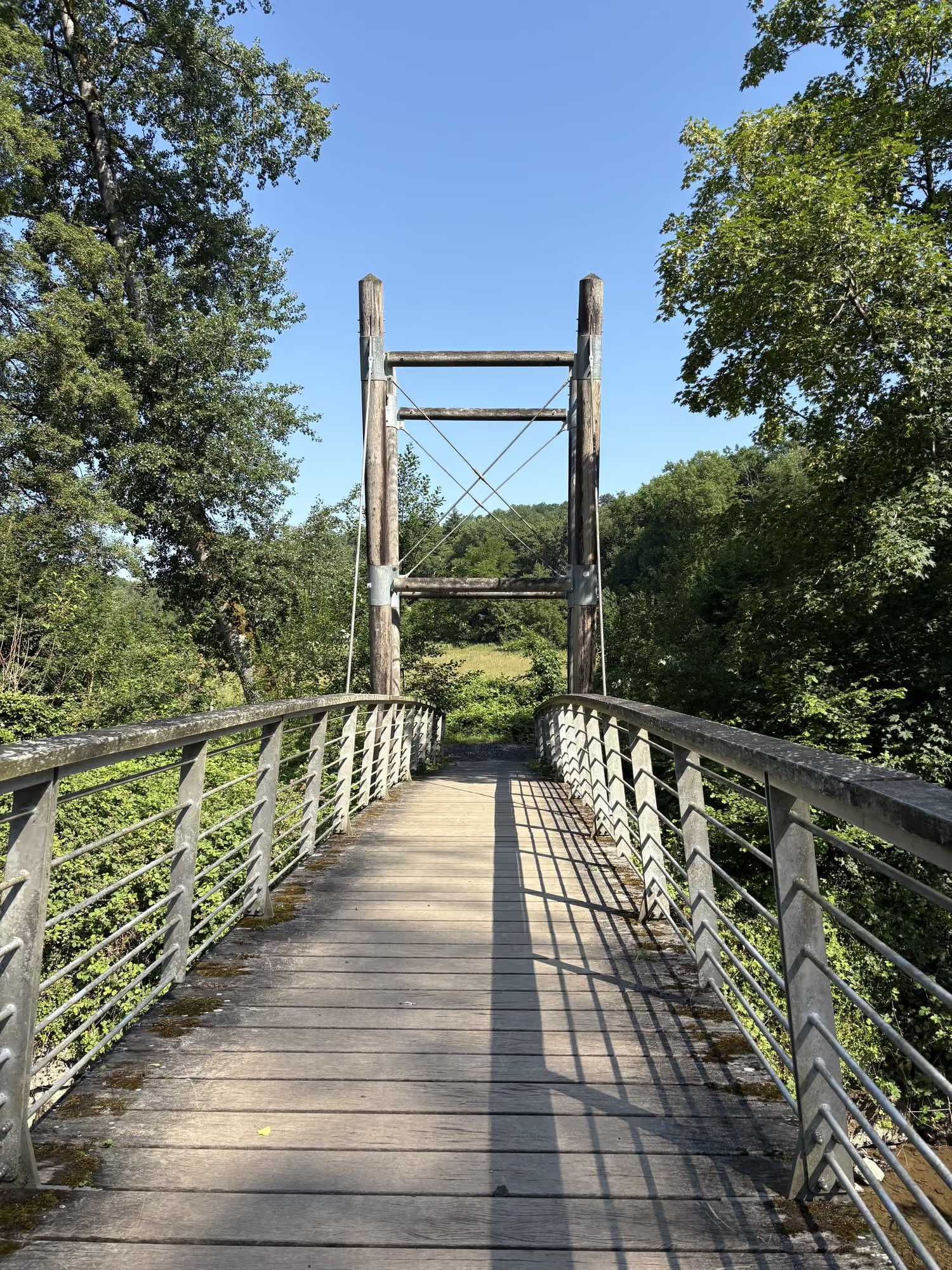
One thing to avoid: the waymarked Promenade de Walzin is a 10 km loop that starts in Falmagne. It is a different walk, and it does not lead to this spot.
Coffee and Belgian cookies by the river
This is the first long stop of the morning, and we give it about 45 minutes. I lay out coffee, tea, Belgian cookies and chocolate, and the castle story gets told while we sit. I pick the chocolate myself and tell you why, rather than offering a choice.
The cookie with the best story is speculoos. It is a thin, crunchy biscuit with spices like cinnamon, ginger and nutmeg, and a deep caramel taste. In Belgium it belongs to Saint Nicholas. On 6 December, he brings speculoos to the children. Belgian bakers have made it for a long time, and it has always sat next to a cup of coffee.
It is a simple stop. It is also the one guests mention most often afterwards.
The airplane cookie: Lotus Biscoff
If you live in the US, you probably know one Belgian speculoos already. You got it on a plane, in a small red wrapper.
That cookie is Lotus. A baker, Jan Boone, started making it in 1932 in Lembeke, a village in East Flanders. He named it after the lotus flower, a sign of purity. His first biscuits followed the speculoos that Belgian children get from Saint Nicholas.
In the 1950s, Lotus started selling the biscuits one by one, each in its own red wrapper. They became the biscuit you got with your coffee in Belgian cafés. That is where the link with coffee comes from.
In the 1980s, the cookie crossed to America. Delta started serving it on its flights instead of peanuts, and many other flights followed. In America it got a new name: Biscoff, from “biscuit” and “coffee”. A Delta employee says he came up with the name. Lotus does not agree. In 2020, Delta said it would swap Biscoff for another cookie. Passengers protested, and Biscoff came back on board.
At home in Belgium, it stayed Lotus Speculoos for a long time. In 2021, Lotus dropped the word speculoos here too. The company wanted one name for the whole world, and by then it already sold the cookie as Biscoff in about 65 countries. So today the Belgian pack says Lotus Biscoff, just like the one on your flight.
The taste did not change. By the Lesse, you simply eat it closer to where it comes from.
When it is not worth it
If you want to walk through rooms and towers, Walzin is not for you. You only see it from the outside. The walk in is short, but it is on a path, so it does not suit anyone who cannot walk for ten minutes. For a castle you can enter, Château de Vêves is nearby.
Days we ran here
- After the usual towns: a Dinant day, August 2024. A snack by the river with the castle in view, after a walk along the water.
- A day for one: Vivien’s Dinant day and Orval, August 2024. Coffee by the river on a day for one guest.
- Our first day: Amy’s day in southern Belgium, July 2024. Coffee and cookies laid out as a small picnic, with the castle in view.
- Stephanie and Joe’s Dinant day, June 2026. Coffee from a moka pot above the castle, with tea, chocolate and biscuits.
- A family of five from Arizona, June 2026. Cookies, chocolates and cold chocolate milk next to the coffee.
- The day after Bastogne, July 2026. Coffee by the Lesse with the castle in view.
- Marie and Steve’s day from Antwerp, September 2026. The first stop of a long day south.
The whole day, stop by stop, is in my guide to Dinant and the Meuse valley. If you want a morning like this, tell us your dates on the private page.
Rather not plan it yourself?
Walzin is the first stop of our day around Dinant and the Meuse valley, with coffee by the river. Pickup at your door in Brussels, Ghent, Antwerp, Bruges or anywhere else in Belgium. Tell us your dates and we build the day around you. Days run year-round on request, and you get a personal reply within 24 hours.
Plan Your Day