
Kasteel Tillegem, outside Bruges
Kasteel Tillegem: a castle park for a picnic outside Bruges
A moated castle in a provincial park just outside Bruges. Its story from 1140 to the war years, what the park holds, and why we set up lunch on its lawn.
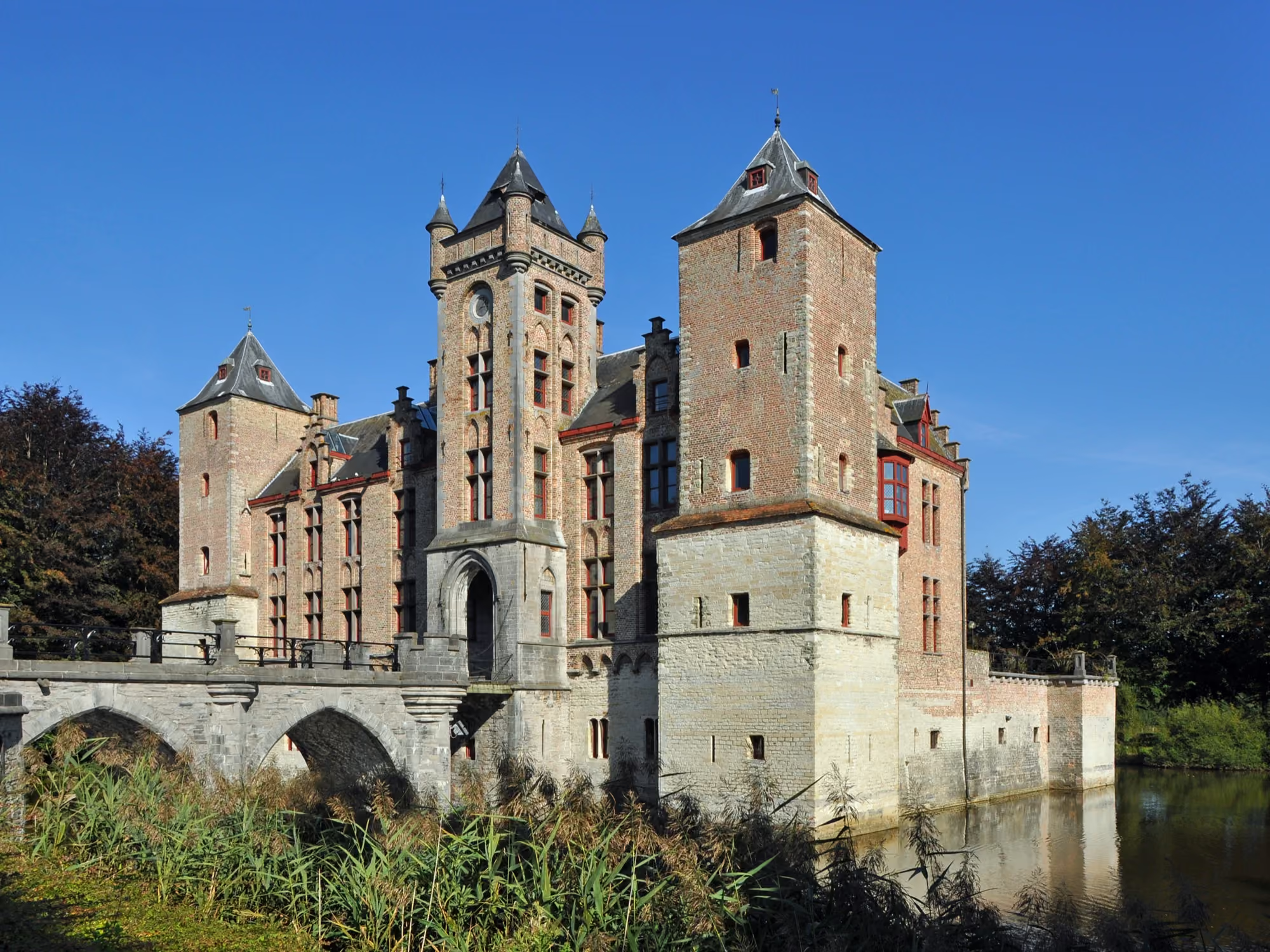
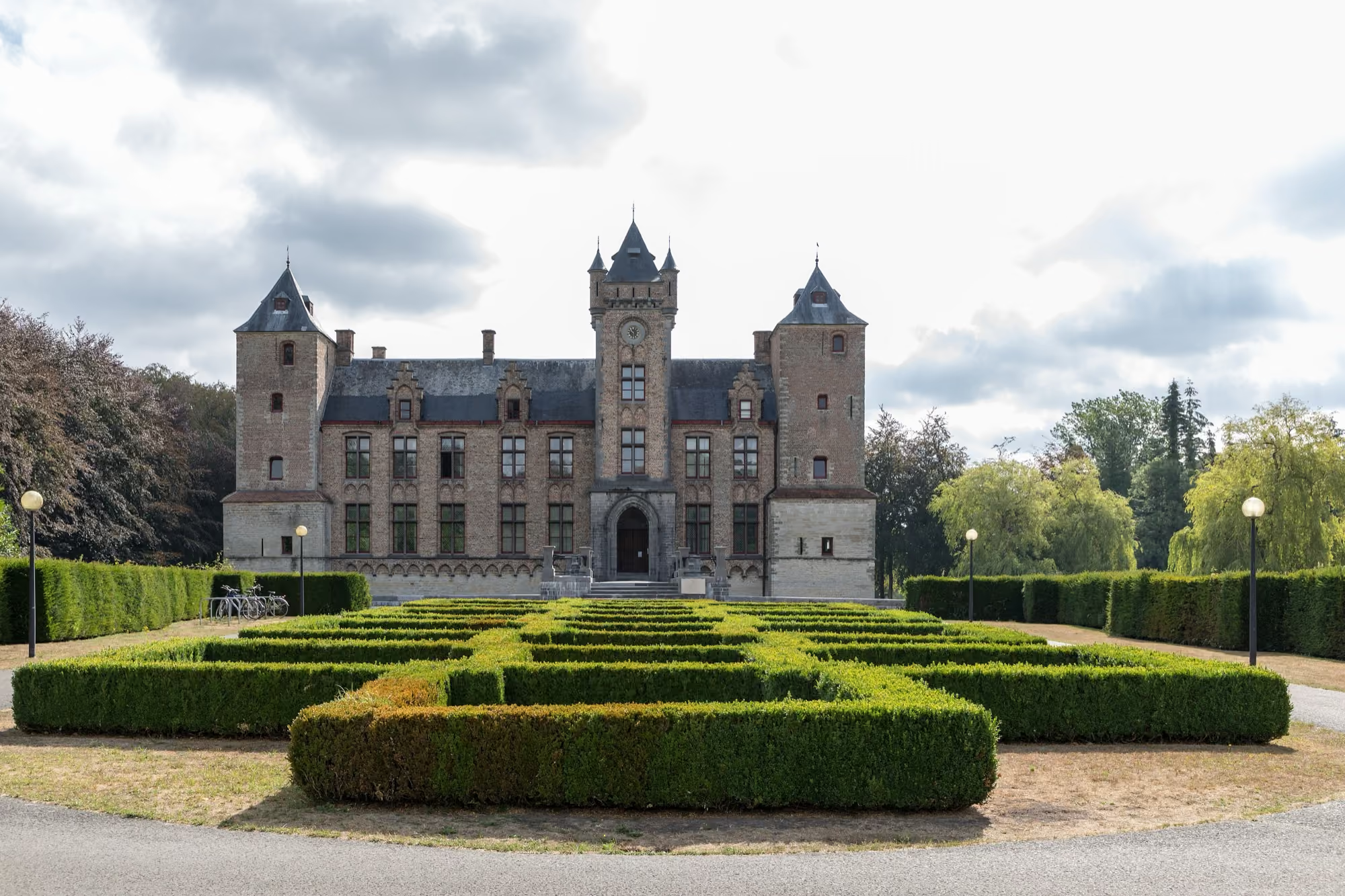
Kasteel Tillegem is a castle surrounded by water, in a park of the Province of West Flanders in Sint-Michiels, just outside Bruges. The castle holds offices today. The lawn in front of it is where we set up lunch.
How I found it
I found Tillegem on a date with my girlfriend.
On 21 June 2026 it was lunch on Cynda C.’s roots day. She and her family had spent the morning in Meulebeke and Aarsele, the two villages her family came from. Bruges was next. Instead of a restaurant in the city, I set up a picnic at a table on the lawn in front of the castle. They did not know until we got there.
Why outdoors? A restaurant you can find anywhere. On these days the point of lunch is the tasting. We share a few Belgian beers at one table, and I tell why beer runs so deep in this country.
Why stop before Bruges? The city gets crowded, so I like a quiet spot first. We park close to the castle. The guests go and look at it for five to ten minutes while I set the table. Lunch then takes about forty minutes, so the afternoon in Bruges starts rested.
At the end of that day I asked for feedback. The castle and the lunch were the first two things they named.
The place by the bridge
The province tells the story of the castle in its own guide to the domain. The name Tillegem first appears around 1140. It means the place by the “tille”, the bridge over the Kerkebeek stream. So Tillegem began as a fortified spot that guarded a crossing.
About 200 metres south-east of the castle lies a mote. It is a raised mound with two round ditches around it. The first wooden tower that watched the bridge probably stood there. A drawing from 1573 already shows it. Part of the mound was dug away when the N31 road was built.
From stone castle to neo-Gothic
Nobody knows exactly when the first stone castle went up. The province dates the first castle on this spot to the second half of the fourteenth century. A sixteenth-century book of hours shows it as a square building with corner towers and a heavy keep over the gate.
In 1641 Antonius Sanderus printed it in his book of Flemish views, the Flandria Illustrata. It shows four wings around a courtyard, with a farmyard beside it. A walled garden in eight parts lay next to the castle. A piece of that garden wall still stands south of the castle.
The owners changed often. In 1285 a rich Bruges citizen, Jan Hubrecht, bought Tillegem. In 1302 he sided with the pro-French party, the Leliaerts, and lost all he had. From 1718 the Le Bailly de Tilleghem family held it for more than 150 years. They grew the estate from 120 to 400 hectares. They also kept the new road to Torhout, built under Austrian rule, away from the castle. Later the railway from Bruges to Torhout ran in full view of it, to the anger of Hector Le Bailly.
What you see today is mostly from the late nineteenth century. After 1879 the new owner, Eugène Charles de Pênaranda, wanted a medieval look. Jean-Baptiste de Bethune led the works in the neo-Gothic style. The tower at the entrance was added then, modelled on the old keep that had gone. A castle farm in the same style followed in 1884. The chapel at the start of the drive got a neo-Gothic form too.
In 1980 René Verhaegen, the last family owner, sold the castle to the province. It was restored between 1985 and 1987.
The castle today
The castle is now a regional house of the province, with offices and meeting rooms. The upper floors were rebuilt as offices. On the ground floor, an oak staircase in Louis XV style survives, with paintings by the Bruges landscape painter Gaeremyn. The cellars from the fourteenth century, with thick walls and brick vaults, are still in their original state.
These are working rooms, not a museum. Plan to see the castle from the outside.
The war years
The Second World War came close. In turn, the castle housed the Hitler Youth, the German navy and sick soldiers. The Germans also built an ammunition depot in the wood. It was cleared again in 1943.
Next door, the castle of Ter Linden was the intelligence headquarters of the German navy. From there they tracked every ship in the Channel between England and France. Allied bombers struck it at Pentecost 1944. The first raid missed and hit the centre of Sint-Michiels. The second left Ter Linden in ruins. The province’s guide says this cleared the way for the landing in Normandy.
On 10 November 1942, the Germans executed eight Belgian civilians at the edge of the wood. They had been brought from the prison in Ghent. One of them was a priest from Zevenkerke, Don Anselme. The Cross of the Executed marks the spot.
The park around it
The castle stands in Tillegembos, the first domain the province ever bought. It started with 44 hectares in 1963. By 2023 the domain covered 144 hectares. Since 2012 it links up with the Bruges city woods of Tudor, Beisbroek, Chartreuzen and Foreest.
It is a mix of woods, lawns and grassland full of flowers. There is a play area of 3,500 square metres and a wood for children to play in. The country inn In de Trutselaar sits in an old farm. A “trutselaar” is the Bruges word for someone who takes their time.
Behind the inn stands a horse mill. It came from Houtem near Veurne and was rebuilt here. Horses turned the gear, and the mill ground grain for cattle feed.
Near the Cross of the Executed lies what is left of the Ster, the star. It was a circle where seven lanes set off, each one aimed at a landmark. Six pointed at church towers: Our Lady in Bruges, Sint-Andries, Oostkamp, Snellegem, Zedelgem and Loppem. The seventh pointed at the Strokot mill in Loppem. A piece of the circle and four lanes remain. The Le Bailly family probably laid it out.
Near the old castle garden, the province built a cellar for bats, based on an old ice cellar. In autumn, mushrooms line the sunny lanes. The red fly agaric with white spots shows up in parts of the wood.
Three walks start in the domain. The Tillegem walk is 1.9 kilometres, the nature walk 3 kilometres. The Three Castles walk is 12 kilometres and links Tillegem with the castles of Tudor and Beisbroek. The signposted Castles cycle route of 48 kilometres starts at the castle.
When it is not worth it
The castle is a working office, not a museum. If you want to walk through a castle, this is not the one. In the Meuse valley, Château de Vêves is a castle you can walk all the way into.
It is a public park, not a restaurant. If you want a lunch with a menu, go to the inn In de Trutselaar in the park.
Days we ran here
- Cynda C.’s roots day, 21 June 2026: Meulebeke and Aarsele in the morning, a picnic lunch at Tillegem, then Bruges with a partner guide.
If you want a lunch like this on a private day, tell us your dates.
Planning a day in Belgium?
We run private days across Belgium: hotel pickup, meals and drinks, one party per day. Tell us your dates and we build the day around you. Days run year-round on request, and you get a personal reply within 24 hours.
Plan Your Day