
Like visiting an old friend, March 2025
Like visiting an old friend: Michael and Christi's day, March 2025
Michael H. and Christi M. from the US spent a March day with me: coffee and cookies by Walzin, a beer tasting above the gardens of Freÿr, Maison Leffe and Chimay.
On Saturday 22 March, Michael H. and Christi M. from the United States spent the day with me in the south of Belgium. They had booked the day on Viator. Christi wrote her review a few weeks later, and Michael wrote his on Google.
A history lesson on the way
I picked them up at their hotel, and the day started in the car. On the way south we talked about Belgium: the economy, the people and the regions. Christi called it a personal history lesson. Here is the part about money, because it explains a lot of what you see from the car window.
Why the south was rich
For most of Belgian history, the money sat in the south. Liège was the capital of its own small state for about eight hundred years. From around 985 until 1795 it was a prince-bishopric: a land ruled by a bishop who was also a prince. As early as the 12th and 13th centuries, the iron masters of Liège were refining iron in a way that became known as the Walloon method.
Then came coal and steam. Belgium was the first country on the European mainland to follow Britain into the industrial revolution, and it did so on the coal and iron of Wallonia. In 1817 an Englishman, John Cockerill, founded his iron works at Seraing near Liège, behind the old château of the prince-bishops. In 1835 his works built Belgium’s first steam locomotive. By 1840 they employed about 3,000 people.
Liège had its forges and its gun makers. Charleroi had its nail factories and, later, its glass. In 1892, 44 of the 50 biggest companies in Belgium, leaving out the banks, were heavy industry, and most of them were in Wallonia.
Flanders, in the meantime, was poor and rural. When its textile trade collapsed around 1840, it was hit hard.
Why the north is rich now
The turn came after the Second World War. Wallonia’s mines and mills were old, the coal was running out and digging it cost more every year. The coal crisis of 1955 to 1958 and the steel crisis of 1974 hit the south harder than anywhere else.
Flanders went the other way. From the late 1950s, foreign money came north, close to the ports and the new motorway to Germany. In 1962 a steel plant by the sea opened in Ghent, and car plants and refineries followed. By the 1960s Flemish industry had caught up, and since then Flanders has been the richer half of the country.
You see it on the road. In the valleys of the south, many villages are quiet. The work is in Brussels and the big cities, and a lot of the houses are second homes of Flemish families. And it explains much of Belgian politics: since 1993, Belgium has been a federal state with three regions, each running a large part of its own affairs.
Coffee and cookies by Walzin
The first stop was the quiet spot across the Lesse from Château de Walzin. I laid out coffee and several kinds of Belgian cookies, and we looked at the castle on its cliff while they tasted them.
A tasting above the gardens of Freÿr
Then came the beer tasting, in a private spot on the cliff above Château de Freÿr. From up there you look straight down onto the French gardens and the Meuse along the estate. It is the best photo of the day, and we had the spot to ourselves.
Maison Leffe in Dinant
In Dinant we stopped at Maison Leffe, the visitor centre of the Leffe beer brand. Leffe is an abbey beer, named after the Abbey of Notre-Dame de Leffe, founded in 1152. It is not a Trappist. That makes it a good contrast before the last stop of the day.
Chimay, the real thing
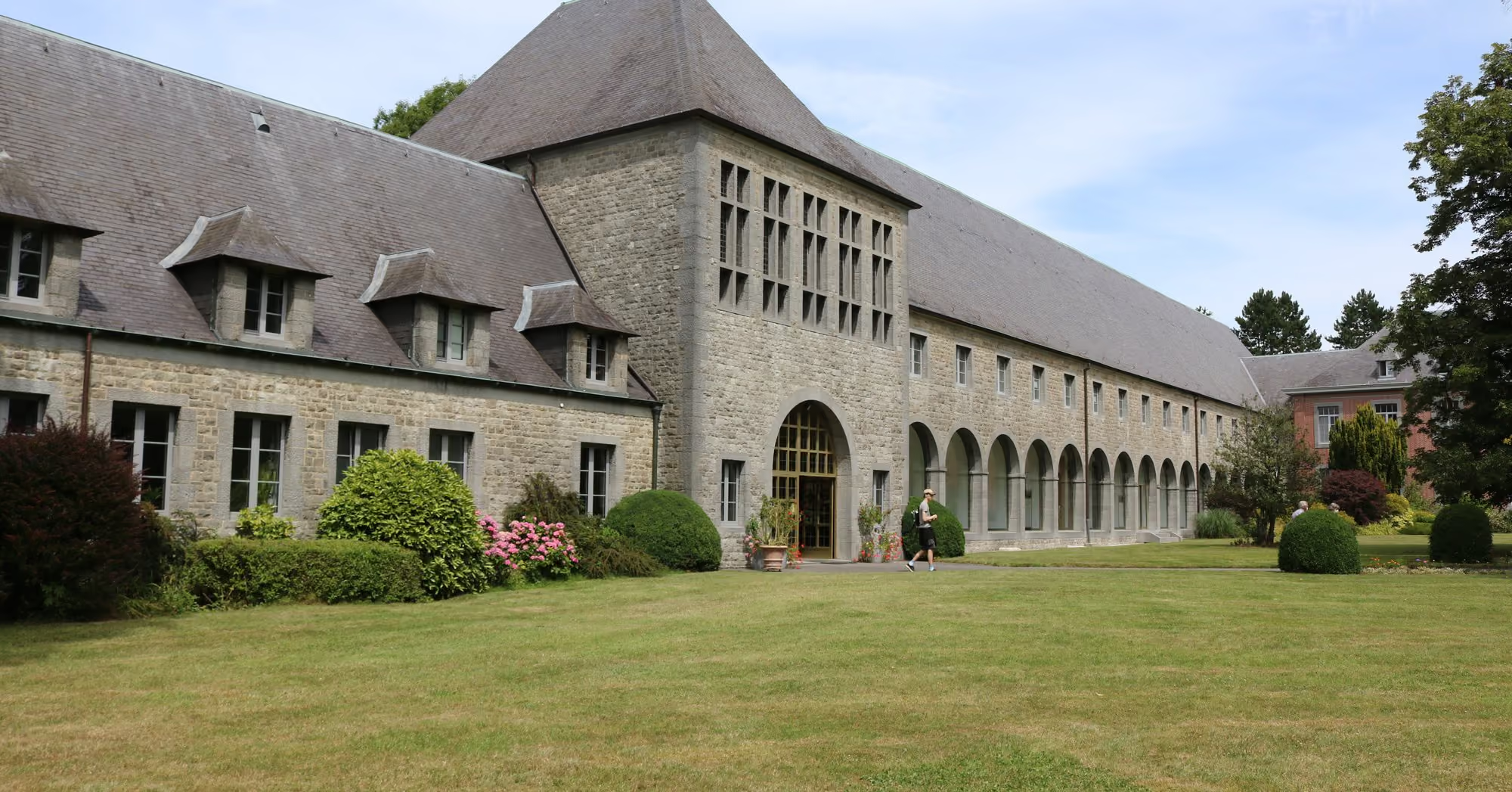
We ended at Chimay. Chimay is a Trappist beer, brewed by the monks of Scourmont Abbey. Christi wrote that visiting the monastery was really nice, and that Chimay was amazing. By then they had tasted many different beers.
Why Scourmont felt so far away
Scourmont Abbey sits on a plateau in the woods near the French border. It is very hard to reach without a car, and the tourist crowds do not come here. Christi felt how secluded it was, and that is no accident. The abbey is hidden on purpose: it is where the monks live, work and pray. Visitors may walk into the garden, the church and the monks’ cemetery. The rest belongs to the community.
That day, Michael and Christi saw one of the monks: a real Trappist monk, at his own abbey. They told me afterwards how grateful they were to have seen something that rare. In two months of travelling through Europe, they said, it was the most unique thing they experienced.
No queues anywhere
Both of them wrote about the timing. They did not wait in line once. I plan the order of the stops around their opening and departure times, so the day keeps moving.
In their words
Christi posted this review on TripAdvisor, as Christi M.
This tour was our favorite adventure in Belgium. Joris picked us up at our hotel and started the journey with a personal history lesson. We learned so much about the economy, people and areas. Our first stop included coffee and tasting various types of cookies while enjoying beautiful views of the castle. Beer tasking in a private setting overlooking the gardens. Visiting the monastery was really nice. Chimay was amazing! Joris’ timing was impeccable at each stop. We didn’t wait in line at all. We tasted many different beers and learned so much. Being with Joris was like hanging out with a friend. He is a native and loves his country. With this personal tour, you get to see a lot of places that you wouldn’t typically have access to with a bus tour group.
Christi M., on TripAdvisor, May 2025
Michael posted his on Google.
This was the best tour! Joris was our very own personal tour guide. Hanging out for an entire day was like visiting an old friend. He’s a native and takes pride in his country. We learned so much about the economy, people, food and beer. Didn’t wait in lines. Visited many places that you typically don’t get to see on large tours. Joris has the ability to help create your own personal tour. Booking with Joris supports small business owners.
Michael H., on Google, 2025
Hanging out for an entire day was like visiting an old friend.
Michael H., on Google
A day like this
This day suits travellers who like their history with a glass in hand, and who want to taste the difference between an abbey beer and a Trappist. It also works outside the summer: the viewpoint above Freÿr sits outside the estate, so it is there even when the château is closed. It suits you less if you do not drink beer, though there is always a non-alcoholic option on the table.
What would a day like this cost today? Read what a private day in Belgium costs, and what is in it.
If you want a day like this, tell us your dates on the private page.
A day like this one
This is one of the private days we run, with pickup at your door in Brussels, Ghent, Antwerp, Bruges or anywhere else in Belgium. Lunch and drinks throughout, one party per day. Tell us your dates and we build the day around you. Days run year-round on request, and you get a personal reply within 24 hours.
Plan Your Day