
Orval, on the French border
Orval: the abbey of the trout and the golden valley
Orval is a Trappist abbey on the French border, with medieval ruins you can walk through, a legend about a trout and a ring, and one of Belgium's five Trappist beers.
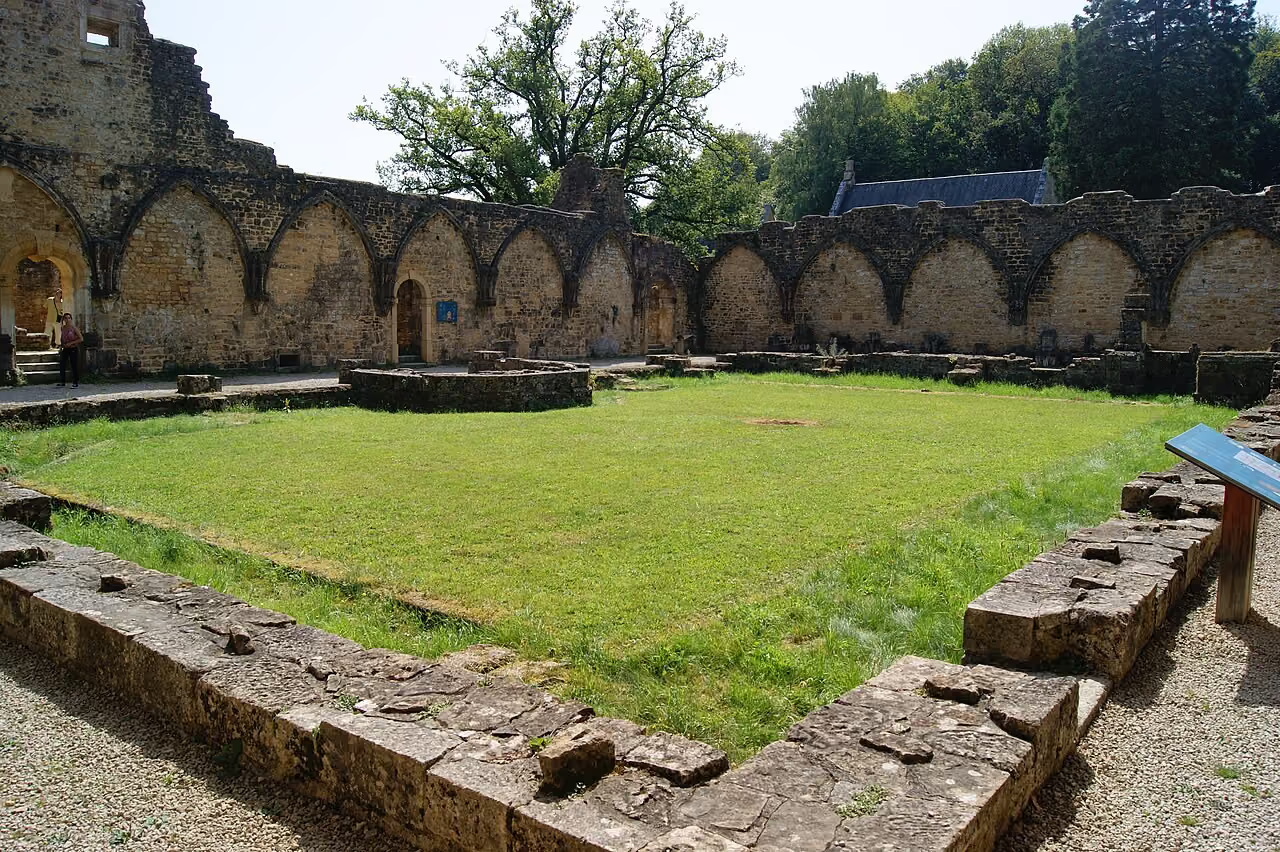
Orval is a Trappist abbey at Villers-devant-Orval, in the far south of Belgium, almost on the French border. Next to the working abbey stand the ruins of the medieval one, and you can walk through them. The monks also brew one of Belgium’s five Trappist beers.
Orval on Vivien’s day
In August 2024 I brought Vivien from Australia here, on a day for one. We had coffee at Château de Walzin in the morning, went underground at Grotte de Lorette, and then drove south to Orval in the afternoon. It is a long drive from Dinant, deep into the south.
The legend of the golden valley
The abbey tells its own legend on its website. A countess, Matilda of Tuscany, had lost her husband. One day she lost her wedding ring in a spring here. She prayed, and a trout came up to the surface with the ring in its mouth.
She called the place a valley of gold, a Val d’Or. To give thanks, she founded a monastery on the spot. That is where the name Orval comes from.
The spring is still there. In the ruins it is called Mathilda’s Fountain, and it still runs. A stained glass window by Jean Huet shows the countess with the trout at her feet. And the trout with the ring is on every bottle of Orval.
Nine hundred years, three abbeys
The real story begins in 1070. Monks from southern Italy settled here. Count Arnould de Chiny, the local lord, welcomed them and gave them land, and they started on a church. About forty years later they left, nobody knows why. A small group of canons took over and finished the church, which was consecrated in 1124.
In 1131, seven Cistercian monks arrived from the abbey of Trois-Fontaines in Champagne, sent at the request of Saint Bernard. From then on, Orval was a Cistercian abbey. The monks also ran forges on their lands, and from the late 1600s to the mid 1700s their forges were a leading force in the iron and steel industry of the region.
The abbey did not have an easy life. A fire gutted it in 1252. Troops pillaged it in 1637. In the 1700s it grew again, and by 1723 it had 130 monks. From 1760 the monks built a large new monastery, designed by the architect Laurent-Benoît Dewez. Its church was consecrated in 1782.
It did not last. On 23 June 1793, French revolutionary troops sacked and burned the abbey. Two years later the community was dissolved. For more than a century, Orval was a ruin in the woods.
In 1926 the de Harenne family gave the ruins to the Cistercian order, so that monks could live here again. The architect Henry Vaes designed a new monastery on the foundations of the 18th-century one. The new church was consecrated on 8 September 1948. That is the abbey the monks live in today, right next to the medieval ruins.
A brewery to pay for the walls
Rebuilding an abbey costs money. So in 1931 the monks started a brewery, to pay for the work. According to the abbey, the beer owes its taste to its water, its hops and its yeast. It is dry hopped the English way. It ferments with the original yeast and with a wild yeast, and then again in the bottle.
Orval is one of the five Belgian Trappist beers, with Chimay, Rochefort, Westmalle and Westvleteren. A Trappist beer is brewed inside the walls of a Trappist abbey, under the monks’ control.
The brewery itself is closed to visitors. It opens only on one open day a year, in September, and you have to register for it on the abbey’s website. One building in the visitor area shows how the beer is made.
What you see
The visit takes about two hours. You walk through the ruins of the old abbey along a route that explains each part. You see Mathilda’s Fountain in the valley. There is a short video of about ten minutes on the history of the abbey and the life of the monks today. In the 18th-century cellars there is a museum of religious art. And there is a garden of medicinal herbs, next to the objects of the old monks’ pharmacy.
In July and August there are guided tours every afternoon, and in September on Sunday afternoons. They are in French and Dutch and take about an hour.
At the Ange Gardien
Next to the abbey is the inn, À l’Ange Gardien, with a view of the abbey. This is where you taste the beer. It serves Orval, and on tap it has green Orval, which the inn offers as an exclusive. You can taste Orval cheese with it, made at the abbey too. The kitchen cooks with food from the region.
The abbey shop sells the beer every day of the year, up to two crates of ten bottles per person.
When it is not worth it
If you want to see beer being brewed, Orval is not the place. The brewery is closed, except on its one open day a year.
It is also far. From Brussels or Ghent, Orval is a long way south, so it only makes sense on a day that goes deep into the south of Belgium. And the inn is closed on Wednesdays, so plan around that if the beer is the point.
Days we ran here
- A day for one: Vivien’s Dinant day and Orval, August 2024. Walzin, the cave at Lorette, and Orval in the afternoon.
If you want a day that reaches Orval, tell us your dates on the private page.
Orval on your day
Orval sits far south, almost on the French border, and it can be part of a private day in the south of Belgium. Pickup at your door in Brussels, Ghent, Antwerp, Bruges or anywhere else in Belgium. Tell us your dates and we build the day around you. Days run year-round on request, and you get a personal reply within 24 hours.
Plan Your Day